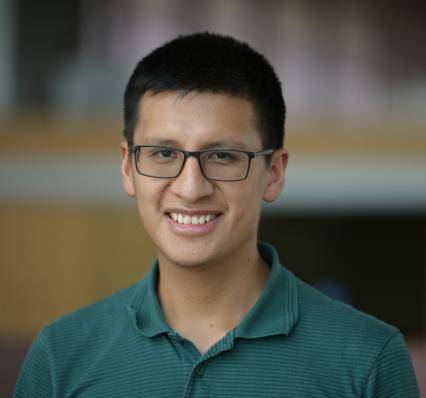
Fernando Zhapa-Camacho
Hi, I am Fernando Zhapa-Camacho. I am a PostDoc at KAUST in Saudi Arabia in the BORG group, led by prof. Robert Hoehndorf, where I also completed my Ph.D. My research interests are neuro-symbolic AI, ontology embedding and representation learning, with applications to bioinformatics.


Software

mOWL — a Python library for machine learning with ontologies formalized in OWL. It implements ontology embedding methods that map formal knowledge bases into vector spaces while preserving their semantics, together with methods that use those embeddings for similarity computation, deductive inference and zero-shot learning. I am the lead developer.


Selected Publications

A homotopy-type-theoretic generalization of neurosymbolic inference

NeSy 2026

Fernando Zhapa-Camacho, Robert Hoehndorf

A type-theoretic account of neurosymbolic inference that explains reasoning shortcuts as a symmetry, and corrects for them in closed form.

A homotopy-type-theoretic generalization of neurosymbolic inference

A wide range of neurosymbolic (NeSy) systems compute one functional: a belief-weighted sum of a logical quantity over a space of σ-structures, of which weighted model counting, fuzzy logic, and probabilistic logic are special cases. This account is built on sets, and a set deliberately forgets two things that are important for NeSy: when two σ-structures are the same up to a symmetry of the theory, and how many distinct proofs witness a query. Replacing the underlying sets by types, in the sense of homotopy type theory, preserves this information, and turns this functional into a belief-weighted homotopy cardinality, a notion of size that counts each object in inverse proportion to its symmetries. We develop the framework from scratch for NeSy systems, prove a conservativity theorem that recovers the classical functional when symmetries are trivial, and show that the symmetry our framework exposes is exactly the one behind reasoning shortcuts. The payoff is concrete: the shortcut-aware concept posterior that recent methods reach by ensembling or expressive density estimation is the only symmetry-invariant point of the confusion-set simplex, computable in closed form by averaging a single model over the symmetry group. On MNIST reasoning-shortcut benchmarks this single-model wrapper is better calibrated than a diversity-trained ensemble, while leaving label accuracy and identifiable concepts untouched.

@misc{zhapacamacho2026hottnesy,
      title={A homotopy-type-theoretic generalization of neurosymbolic inference},
      author={Fernando Zhapa-Camacho and Robert Hoehndorf},
      year={2026},
      eprint={2606.17851},
      archivePrefix={arXiv},
      primaryClass={cs.LG}
}
ArXiv GitHub
icon


INDIGENA: inductive prediction of disease-gene associations using phenotype ontologies

Bioinformatics

Fernando Zhapa-Camacho, Robert Hoehndorf

Ranks candidate disease genes from a set of phenotypes, and unlike earlier embedding methods generalises to diseases unseen at training time.

INDIGENA: inductive prediction of disease-gene associations using phenotype ontologies

Motivation: Predicting gene-disease associations (GDAs) is the problem to determine which gene is associated with a disease. GDA prediction can be framed as a ranking problem where genes are ranked for a query disease, based on features such as phenotypic similarity. By describing phenotypes using phenotype ontologies, ontology-based semantic similarity measures can be used. However, traditional semantic similarity measures use only the ontology taxonomy. Recent methods based on ontology embeddings compare phenotypes in latent space; these methods can use all ontology axioms as well as a supervised signal, but are inherently transductive, i.e., query entities must already be known at the time of learning embeddings, and therefore these methods do not generalize to novel diseases (sets of phenotypes) at inference time. Results: We developed INDIGENA, an inductive disease-gene association method for ranking genes based on a set of phenotypes. Our method first uses a graph projection to map axioms from phenotype ontologies to a graph structure, and then uses graph embeddings to create latent representations of phenotypes. We use an explicit aggregation strategy to combine phenotype embeddings into representations of genes or diseases, allowing us to generalize to novel sets of phenotypes. We also develop a method to make the phenotype embeddings and the similarity measure task-specific by including a supervised signal from known gene-disease associations. We apply our method to mouse models of human disease and demonstrate that we can significantly improve over the inductive semantic similarity baseline measures, and reach a performance similar to transductive methods for predicting gene-disease associations while being more general. Availability and Implementation: https://github.com/bio-ontology-research-group/indigena

@article{Zhapa_Camacho_2026_indigena,
  title={INDIGENA: inductive prediction of disease–gene associations using phenotype ontologies},
  volume={42},
  ISSN={1367-4811},
  url={http://dx.doi.org/10.1093/bioinformatics/btag325},
  DOI={10.1093/bioinformatics/btag325},
  number={6},
  journal={Bioinformatics},
  publisher={Oxford University Press (OUP)},
  author={Zhapa-Camacho, Fernando and Hoehndorf, Robert},
  editor={Robinson, Peter},
  year={2026},
  month=May
}
Paper GitHub


Fully Geometric Multi-Hop Reasoning on Knowledge Graphs with Transitive Relations
ESWC 2026

Fernando Zhapa-Camacho, Robert Hoehndorf

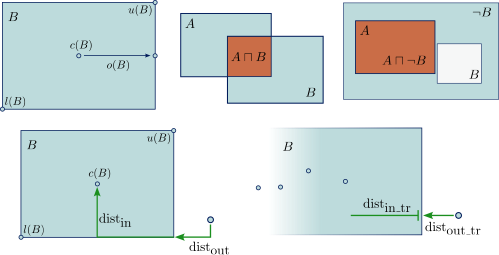
Multi-hop reasoning where logical operations are genuine geometric transformations rather than learned neural components, with a loss that preserves transitivity.

Fully Geometric Multi-Hop Reasoning on Knowledge Graphs with Transitive Relations

Geometric embedding methods have shown to be useful for multi-hop reasoning on knowledge graphs by mapping entities and logical operations to geometric regions and geometric transformations, respectively. Geometric embeddings provide direct interpretability framework for queries. However, current methods have only leveraged the geometric construction of entities, failing to map logical operations to geometric transformations and, instead, using neural components to learn these operations. We introduce GeometrE, a geometric embedding method for multi-hop reasoning, which does not require learning the logical operations and enables full geometric interpretability. Additionally, unlike previous methods, we introduce a transitive loss function and show that it can preserve the logical rule $\forall a,b,c : r(a,b) \land r(b,c) \to r(a,c)$ . Our experiments show that GeometrE outperforms current state-of-the-art methods on standard benchmark datasets.

@inbook{Zhapa_Camacho_2026_geometre,
  title={Fully Geometric Multi-hop Reasoning on Knowledge Graphs with Transitive Relations},
  ISBN={9783032251565},
  ISSN={1611-3349},
  url={http://dx.doi.org/10.1007/978-3-032-25156-5_14},
  DOI={10.1007/978-3-032-25156-5_14},
  booktitle={The Semantic Web},
  publisher={Springer Nature Switzerland},
  author={Zhapa-Camacho, Fernando and Hoehndorf, Robert},
  year={2026},
  pages={258–277}
}
ArXiv GitHub
icon


Lattice-Based ALC Ontology Embeddings With Saturation

Neurosymbolic Artificial Intelligence also in NeSy 2024

Fernando Zhapa-Camacho, Robert Hoehndorf

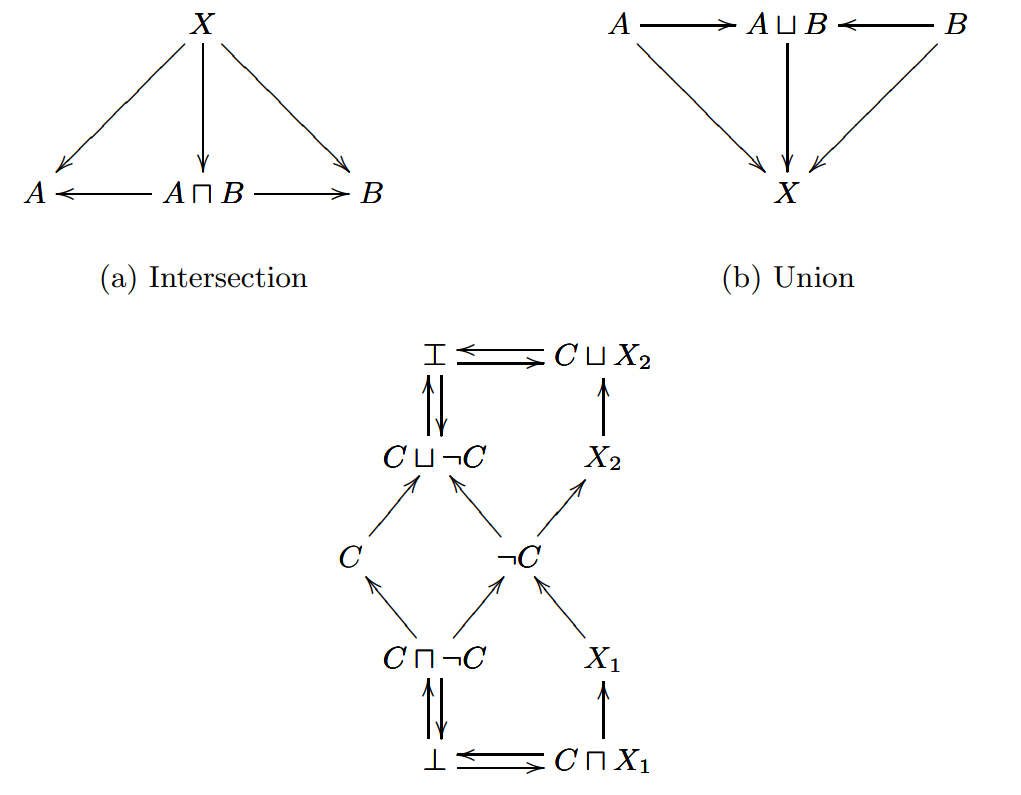
Embeds ALC ontologies by preserving the lattice structure of concept descriptions, working on the many real ontologies that contain no individuals; the journal version adds logical saturation so the model sees inferred axioms and not only asserted ones.
Lattice-Based ALC Ontology Embeddings With Saturation

Generating vector representations (embeddings) of OWL ontologies is a growing task due to its applications in predicting missing facts and knowledge-enhanced learning in fields such as bioinformatics. The underlying semantics of OWL ontologies is expressed using Description Logics (DLs). Initial approaches to generate embeddings relied on constructing a graph out of ontologies, neglecting the semantics of the logic therein. Recent semantic-preserving embedding methods often target lightweight DL languages like EL++, ignoring more expressive information in ontologies. Although some approaches aim to embed more descriptive DLs like ALC, those methods require the existence of individuals, while many real-world ontologies are devoid of them. We propose an ontology embedding method for the ALC DL language that considers the lattice structure of concept descriptions. We use connections between DL and Category Theory to materialize the lattice structure and embed it using an order-preserving embedding method. We show that our method outperforms state-of-the-art methods in several knowledge base completion tasks. We make our code and data available at https://github.com/bio-ontology-research-group/catE

Neurosymbolic Artificial Intelligence
@article{Zhapa_Camacho_2025,
title={Lattice-Based ALC Ontology Embeddings With Saturation},
volume={1},
ISSN={2949-8732},
url={http://dx.doi.org/10.1177/29498732251340186},
DOI={10.1177/29498732251340186},
journal={Neurosymbolic Artificial Intelligence},
publisher={SAGE Publications},
author={Zhapa-Camacho, Fernando and Hoehndorf, Robert},
year={2025},
month=jun }
NeSy 2024
@InProceedings{10.1007/978-3-031-71167-1_19,
author="Zhapa-Camacho, Fernando
and Hoehndorf, Robert",
editor="Besold, Tarek R.
and d'Avila Garcez, Artur
and Jimenez-Ruiz, Ernesto
and Confalonieri, Roberto
and Madhyastha, Pranava
and Wagner, Benedikt",
title="Lattice-Preserving {\$}{\$}{\backslash}mathcal {\{}ALC{\}}{\$}{\$}Ontology Embeddings",
booktitle="Neural-Symbolic Learning and Reasoning",
year="2024",
publisher="Springer Nature Switzerland",
address="Cham",
pages="355--369",
isbn="978-3-031-71167-1"
}
Paper GitHub
icon


Ontology Embedding: A Survey of Methods, Applications and Resources

IEEE TKDE

Jiaoyan Chen, Olga Mashkova, Fernando Zhapa-Camacho, Robert Hoehndorf, Yuan He, Ian Horrocks

A systematic survey of ontology embedding: formal definitions, families of methods, applications and available resources.

Ontology Embedding: A Survey of Methods, Applications and Resources

Ontologies are widely used for representing domain knowledge and meta data, playing an increasingly important role in Information Systems, the Semantic Web, Bioinformatics and many other domains. However, logical reasoning that ontologies can directly support are quite limited in learning, approximation and prediction. One straightforward solution is to integrate statistical analysis and machine learning. To this end, automatically learning vector representation for knowledge of an ontology i.e., ontology embedding has been widely investigated in recent years. Numerous papers have been published on ontology embedding, but a lack of systematic reviews hinders researchers from gaining a comprehensive understanding of this field. To bridge this gap, we write this survey paper, which first introduces different kinds of semantics of ontologies, and formally defines ontology embedding from the perspectives of both mathematics and machine learning, as well as its property of faithfulness. Based on this, it systematically categorises and analyses a relatively complete set of over 80 papers, according to the ontologies and semantics that they aim at, and their technical solutions including geometric modeling, sequence modeling and graph propagation. This survey also introduces the applications of ontology embedding in ontology engineering, machine learning augmentation and life sciences, presents a new library mOWL, and discusses the challenges and future directions.

@article{Chen_2025,
  title={Ontology Embedding: A Survey of Methods, Applications and Resources},
  ISSN={2326-3865},
  url={http://dx.doi.org/10.1109/TKDE.2025.3559023},
  DOI={10.1109/tkde.2025.3559023},
  journal={IEEE Transactions on Knowledge and Data Engineering},
  publisher={Institute of Electrical and Electronics Engineers (IEEE)},
  author={Chen, Jiaoyan and Mashkova, Olga and Zhapa-Camacho, Fernando and Hoehndorf, Robert and He, Yuan and Horrocks, Ian},
  year={2025},
  pages={1–20}
}
Paper


Predicting protein functions using positive-unlabeled ranking with ontology-based priors
ISMB 2024

Fernando Zhapa-Camacho, Zhenwei Tang, Maxat Kulmanov, Robert Hoehndorf

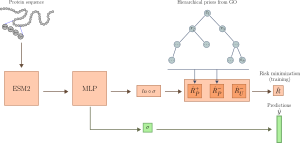
Casts protein function prediction as positive-unlabeled ranking with class priors from the Gene Ontology hierarchy, avoiding the false-negative problem.

Predicting protein functions using positive-unlabeled ranking with ontology-based priors

Automated protein function prediction is a crucial and widely studied problem in bioinformatics. Computationally, protein function is a multilabel classification problem where only positive samples are defined and there is a large number of unlabeled annotations. Most existing methods rely on the assumption that the unlabeled set of protein function annotations are negatives, inducing the false negative issue, where potential positive samples are trained as negatives. We introduce a novel approach named PU-GO, wherein we address function prediction as a positive-unlabeled ranking problem. We apply empirical risk minimization, i.e., we minimize the classification risk of a classifier where class priors are obtained from the Gene Ontology hierarchical structure. We show that our approach is more robust than other state-of-the-art methods on similarity-based and time-based benchmark datasets. Data and code are available at https: //github.com/bio-ontology-research-group/PU-GO.

@article {Zhapa-Camacho2024.01.28.577662,
	  author = {Fernando Zhapa-Camacho and Zhenwei Tang and Maxat Kulmanov and Robert Hoehndorf},
          title = {Predicting protein functions using positive-unlabeled ranking with ontology-based priors},
          elocation-id = {2024.01.28.577662},
          year = {2024},
          doi = {10.1101/2024.01.28.577662},
          publisher = {Cold Spring Harbor Laboratory},
          abstract = {Automated protein function prediction is a crucial and widely studied problem in bioinformatics. Computationally, protein function is a multilabel classification problem where only positive samples are defined and there is a large number of unlabeled annotations. Most existing methods rely on the assumption that the unlabeled set of protein function annotations are negatives, inducing the false negative issue, where potential positive samples are trained as negatives. We introduce a novel approach named PU-GO, wherein we address function prediction as a positive-unlabeled ranking problem. We apply empirical risk minimization, i.e., we minimize the classification risk of a classifier where class priors are obtained from the Gene Ontology hierarchical structure. We show that our approach is more robust than other state-of-the-art methods on similarity-based and time-based benchmark datasets. Data and code are available at https://github.com/bio-ontology-research-group/PU-GO.Competing Interest StatementThe authors have declared no competing interest.},
        URL = {https://www.biorxiv.org/content/early/2024/01/31/2024.01.28.577662},
        eprint = {https://www.biorxiv.org/content/early/2024/01/31/2024.01.28.577662.full.pdf},
        journal = {bioRxiv}
}
Paper GitHub
icon


mOWL: Python library for machine learning with biomedical ontologies

Bioinformatics, Volume 39, Issue 1

Fernando Zhapa-Camacho, Maxat Kulmanov, Robert Hoehndorf

A Python library packaging ontology embedding methods into reusable primitives for machine learning with biomedical ontologies.

mOWL: Python library for machine learning with biomedical ontologies

Motivation Ontologies contain formal and structured information about a domain and are widely used in bioinformatics for annotation and integration of data. Several methods use ontologies to provide background knowledge in machine learning tasks, which is of particular importance in bioinformatics. These methods rely on a set of common primitives that are not readily available in a software library; a library providing these primitives would facilitate the use of current machine learning methods with ontologies and the development of novel methods for other ontology-based biomedical applications.

Results We developed mOWL, a Python library for machine learning with ontologies formalized in the Web Ontology Language (OWL). mOWL implements ontology embedding methods that map information contained in formal knowledge bases and ontologies into vector spaces while preserving some of the properties and relations in ontologies, as well as methods to use these embeddings for similarity computation, deductive inference and zero-shot learning. We demonstrate mOWL on the knowledge-based prediction of protein–protein interactions using the gene ontology and gene–disease associations using phenotype ontologies.

@article{10.1093/bioinformatics/btac811,
	author = {Zhapa-Camacho, Fernando and Kulmanov, Maxat and Hoehndorf, Robert},
    	title = "{mOWL: Python library for machine learning with biomedical ontologies}",
    	journal = {Bioinformatics},
    	year = {2022},
    	month = {12},
    	issn = {1367-4803},
    	doi = {10.1093/bioinformatics/btac811},
    	url = {https://doi.org/10.1093/bioinformatics/btac811},
    	note = {btac811},
   	}
Paper GitHub
icon


News

June, 2026

I successfully defended my Ph.D. at KAUST and continued in the BORG group as a Postdoctoral Researcher

June, 2026

Our paper on a homotopy-type-theoretic generalization of neurosymbolic inference was accepted at NeSy 2026

October, 2025

Our paper on agent-based protein function prediction was accepted at PSB 2026

June, 2025

Added to the CEMSE Dean's List 2025

June, 2024

Publication accepted in NeSy 2024

June, 2024

Added to the CEMSE Dean's List 2024

March, 2024

Publication accepted in ISMB 2024


Hobbies

I practice football (usually as defender) and chess (currently playing a lot the Italian game as white and 1... g6 as black).