Neuro-symbolic methods

Moose: Latent concept learning with reasoning-shortcut awareness in EL++

ISWC 2026

Olga Mashkova, Asaad Mohammedsaleh, Fernando Zhapa-Camacho, Robert Hoehndorf

Compiles an EL++ ontology into a differentiable circuit to learn latent concepts from partially observed ABoxes, and gives the first reasoning-shortcut analysis in an OWL EL setting.

Moose: Latent concept learning with reasoning-shortcut awareness in EL++

The OWL 2 EL profile is used in some of the largest production ontologies, including the Gene Ontology and SNOMED CT. Existing neuro-symbolic (NeSy) learning methods accept propositional theories or Datalog, and reasoning-shortcut (RS) awareness has not been investigated in ontology settings. We present Moose, a method that compiles an EL++ TBox and finite ABox to a Sentential Decision Diagram (SDD). The SDD acts as a differentiable weighted-model-counting layer, and we add closure clauses outside the EL++ profile on declared exhaustive families to overcome the limited expressivity of EL++ under partial supervision. We show termination, soundness, completeness, and polynomial intermediate sizes, and validate the proofs in Lean. We then define the first formal partial-supervision latent-concept-learning task over an OWL EL ontology, i.e., learning per-individual classifiers for latent concepts from observed ABox literals, and evaluate Moose on MNIST-with-ontology and Pizzaïolo. Moose improves over propositional-NeSy, fuzzy-logic, and ontology embedding baselines, and presents the first reasoning-shortcut analysis in an OWL EL setting.

@misc{mashkova2026moose,
      title={Moose: Latent concept learning with reasoning-shortcut awareness in EL++},
      author={Olga Mashkova and Asaad Mohammedsaleh and Fernando Zhapa-Camacho and Robert Hoehndorf},
      year={2026},
      eprint={2608.12961},
      archivePrefix={arXiv},
      primaryClass={cs.AI}
}
ArXiv


Neuro-symbolic learning over OWL 2 DL via consequence-based compilation to differentiable circuits

NeSy 2026

Olga Mashkova, Asaad Mohammedsaleh, Fernando Zhapa-Camacho, Robert Hoehndorf

Compiles a full SROIQ ontology into a differentiable circuit so a perception network can be trained against OWL 2 DL entailment, and shows how to characterize and mitigate reasoning shortcuts in a non-Horn description logic.

Neuro-symbolic learning over OWL 2 DL via consequence-based compilation to differentiable circuits

OWL 2 DL ontologies, grounded in the description logic SROIQ, express large knowledge bases in biomedicine and the Semantic Web. Neuro-symbolic (NeSy) learners over description logics either embed the ontology in a continuous space, abandoning classical entailment, or restrict to the Horn fragment EL++, which has a single canonical model. We present Baobab, which compiles a SROIQ ontology with a finite ABox into a Sentential Decision Diagram (SDD): it saturates a propositional core under a consequence-based calculus and instantiates the remaining SROIQ features (nominals, number restrictions, and the role axioms) over the active domain. The SDD’s evidence-conditioned weighted model count then trains a perception network to recognize real images under partial ABox supervision: on an ontology that exercises every distinctive SROIQ feature, a CNN learns to read MNIST digits coupled by a successor relation and recovers latent ontology concepts that an independent perception leaves at chance. When the supervision admits several ontology-consistent completions, an independent perception collapses onto one, a reasoning shortcut: we show that a mixture indexed by the query’s justifications can represent the calibrated posterior no independent perception can, and that seeding it from the circuit’s enumerated completions attains the Bayes-optimal posterior on a real-image MNIST task where single-WMC and learned mixtures (the BEARS-ensemble hypothesis class) do not: to our knowledge the first to characterize and mitigate reasoning shortcuts in a non-Horn description logic. Soundness of the compiler and the representation result are machine-checked in Lean 4.

@misc{mashkova2026baobab,
      title={Neuro-symbolic learning over OWL 2 DL via consequence-based compilation to differentiable circuits},
      author={Olga Mashkova and Asaad Mohammedsaleh and Fernando Zhapa-Camacho and Robert Hoehndorf},
      year={2026},
      eprint={2608.17741},
      archivePrefix={arXiv},
      primaryClass={cs.AI}
}
ArXiv GitHub


A homotopy-type-theoretic generalization of neurosymbolic inference

NeSy 2026

Fernando Zhapa-Camacho, Robert Hoehndorf

A type-theoretic account of neurosymbolic inference that explains reasoning shortcuts as a symmetry, and corrects for them in closed form.

A homotopy-type-theoretic generalization of neurosymbolic inference

A wide range of neurosymbolic (NeSy) systems compute one functional: a belief-weighted sum of a logical quantity over a space of σ-structures, of which weighted model counting, fuzzy logic, and probabilistic logic are special cases. This account is built on sets, and a set deliberately forgets two things that are important for NeSy: when two σ-structures are the same up to a symmetry of the theory, and how many distinct proofs witness a query. Replacing the underlying sets by types, in the sense of homotopy type theory, preserves this information, and turns this functional into a belief-weighted homotopy cardinality, a notion of size that counts each object in inverse proportion to its symmetries. We develop the framework from scratch for NeSy systems, prove a conservativity theorem that recovers the classical functional when symmetries are trivial, and show that the symmetry our framework exposes is exactly the one behind reasoning shortcuts. The payoff is concrete: the shortcut-aware concept posterior that recent methods reach by ensembling or expressive density estimation is the only symmetry-invariant point of the confusion-set simplex, computable in closed form by averaging a single model over the symmetry group. On MNIST reasoning-shortcut benchmarks this single-model wrapper is better calibrated than a diversity-trained ensemble, while leaving label accuracy and identifiable concepts untouched.

@misc{zhapacamacho2026hottnesy,
      title={A homotopy-type-theoretic generalization of neurosymbolic inference},
      author={Fernando Zhapa-Camacho and Robert Hoehndorf},
      year={2026},
      eprint={2606.17851},
      archivePrefix={arXiv},
      primaryClass={cs.LG}
}
ArXiv GitHub
icon


Fully Geometric Multi-Hop Reasoning on Knowledge Graphs with Transitive Relations
ESWC 2026

Fernando Zhapa-Camacho, Robert Hoehndorf

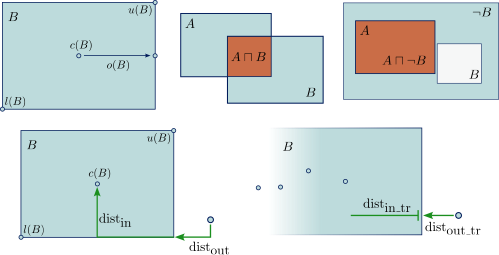
Multi-hop reasoning where logical operations are genuine geometric transformations rather than learned neural components, with a loss that preserves transitivity.

Fully Geometric Multi-Hop Reasoning on Knowledge Graphs with Transitive Relations

Geometric embedding methods have shown to be useful for multi-hop reasoning on knowledge graphs by mapping entities and logical operations to geometric regions and geometric transformations, respectively. Geometric embeddings provide direct interpretability framework for queries. However, current methods have only leveraged the geometric construction of entities, failing to map logical operations to geometric transformations and, instead, using neural components to learn these operations. We introduce GeometrE, a geometric embedding method for multi-hop reasoning, which does not require learning the logical operations and enables full geometric interpretability. Additionally, unlike previous methods, we introduce a transitive loss function and show that it can preserve the logical rule $\forall a,b,c : r(a,b) \land r(b,c) \to r(a,c)$ . Our experiments show that GeometrE outperforms current state-of-the-art methods on standard benchmark datasets.

@inbook{Zhapa_Camacho_2026_geometre,
  title={Fully Geometric Multi-hop Reasoning on Knowledge Graphs with Transitive Relations},
  ISBN={9783032251565},
  ISSN={1611-3349},
  url={http://dx.doi.org/10.1007/978-3-032-25156-5_14},
  DOI={10.1007/978-3-032-25156-5_14},
  booktitle={The Semantic Web},
  publisher={Springer Nature Switzerland},
  author={Zhapa-Camacho, Fernando and Hoehndorf, Robert},
  year={2026},
  pages={258–277}
}
ArXiv GitHub
icon


DELE: Deductive EL++ Embeddings for Knowledge Base Completion

Neurosymbolic Artificial Intelligence also in NeSy 2024

Olga Mashkova, Fernando Zhapa-Camacho, Robert Hoehndorf

Uses the deductive closure of an ontology to separate provably false statements from merely unprovable ones, so EL++ embeddings stop training on entailed facts as if they were negatives.

DELE: Deductive EL++ Embeddings for Knowledge Base Completion

Ontology embeddings map classes, relations, and individuals in ontologies into Rn, and within Rn similarity between entities can be computed or new axioms inferred. For ontologies in the Description Logic EL++, several embedding methods have been developed that explicitly generate models of an ontology. However, these methods suffer from some limitations; they do not distinguish between statements that are unprovable and provably false, and therefore they may use entailed statements as negatives. Furthermore, they do not utilize the deductive closure of an ontology to identify statements that are inferred but not asserted. We evaluated a set of embedding methods for EL++ ontologies, incorporating several modifications that aim to make use of the ontology deductive closure. In particular, we designed novel negative losses that account both for the deductive closure and different types of negatives and formulated evaluation methods for knowledge base completion. We demonstrate that our embedding methods improve over the baseline ontology embedding in the task of knowledge base or ontology completion.

Neurosymbolic Artificial Intelligence
@article{Mashkova_2026,
title={DELE: Deductive EL++ Embeddings for Knowledge Base Completion},
volume={2},
ISSN={2949-8732},
url={http://dx.doi.org/10.1177/29498732261420011},
DOI={10.1177/29498732261420011},
journal={Neurosymbolic Artificial Intelligence},
publisher={SAGE Publications},
author={Mashkova, Olga and Zhapa-Camacho, Fernando and Hoehndorf, Robert},
year={2026},
month=jan }
NeSy 2024
@inbook{Mashkova_2024,
  title={Enhancing Geometric Ontology Embeddings for $$\mathcal{E}\mathcal{L}^{++}$$ with Negative Sampling and Deductive Closure Filtering},
  ISBN={9783031711671},
  ISSN={1611-3349},
  url={http://dx.doi.org/10.1007/978-3-031-71167-1_18},
  DOI={10.1007/978-3-031-71167-1_18},
  booktitle={Neural-Symbolic Learning and Reasoning},
  publisher={Springer Nature Switzerland},
  author={Mashkova, Olga and Zhapa-Camacho, Fernando and Hoehndorf, Robert},
  year={2024},
  pages={331–354}
}
Paper GitHub


Lattice-Based ALC Ontology Embeddings With Saturation

Neurosymbolic Artificial Intelligence also in NeSy 2024

Fernando Zhapa-Camacho, Robert Hoehndorf

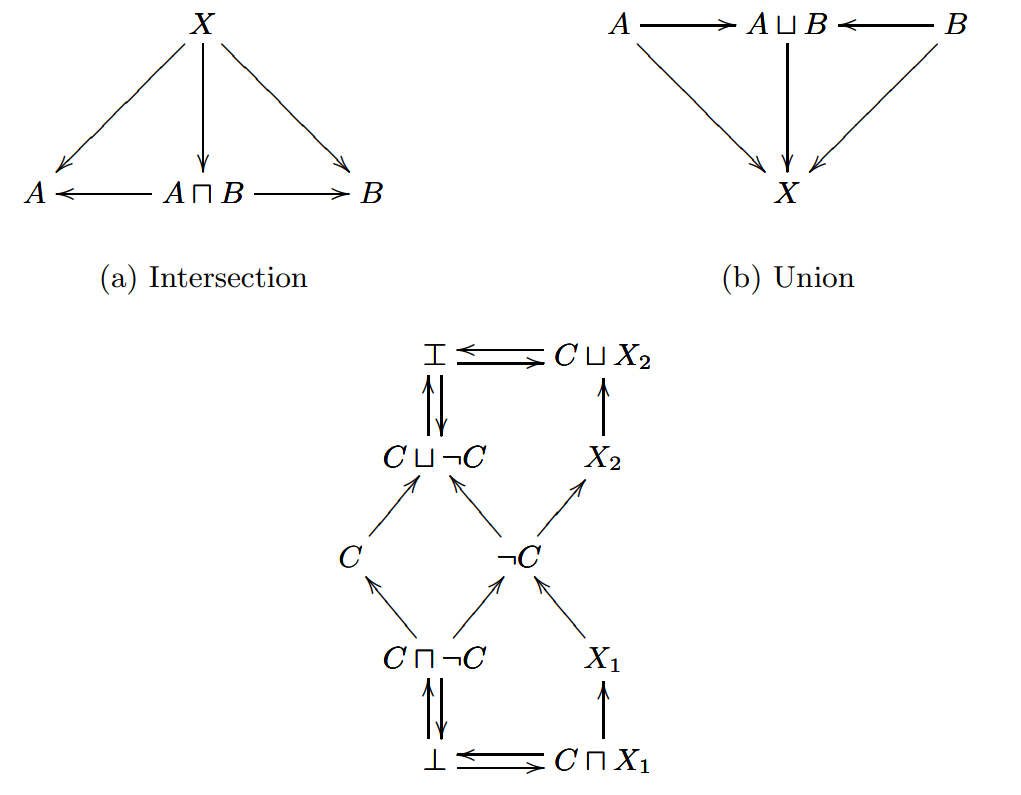
Embeds ALC ontologies by preserving the lattice structure of concept descriptions, working on the many real ontologies that contain no individuals; the journal version adds logical saturation so the model sees inferred axioms and not only asserted ones.
Lattice-Based ALC Ontology Embeddings With Saturation

Generating vector representations (embeddings) of OWL ontologies is a growing task due to its applications in predicting missing facts and knowledge-enhanced learning in fields such as bioinformatics. The underlying semantics of OWL ontologies is expressed using Description Logics (DLs). Initial approaches to generate embeddings relied on constructing a graph out of ontologies, neglecting the semantics of the logic therein. Recent semantic-preserving embedding methods often target lightweight DL languages like EL++, ignoring more expressive information in ontologies. Although some approaches aim to embed more descriptive DLs like ALC, those methods require the existence of individuals, while many real-world ontologies are devoid of them. We propose an ontology embedding method for the ALC DL language that considers the lattice structure of concept descriptions. We use connections between DL and Category Theory to materialize the lattice structure and embed it using an order-preserving embedding method. We show that our method outperforms state-of-the-art methods in several knowledge base completion tasks. We make our code and data available at https://github.com/bio-ontology-research-group/catE

Neurosymbolic Artificial Intelligence
@article{Zhapa_Camacho_2025,
title={Lattice-Based ALC Ontology Embeddings With Saturation},
volume={1},
ISSN={2949-8732},
url={http://dx.doi.org/10.1177/29498732251340186},
DOI={10.1177/29498732251340186},
journal={Neurosymbolic Artificial Intelligence},
publisher={SAGE Publications},
author={Zhapa-Camacho, Fernando and Hoehndorf, Robert},
year={2025},
month=jun }
NeSy 2024
@InProceedings{10.1007/978-3-031-71167-1_19,
author="Zhapa-Camacho, Fernando
and Hoehndorf, Robert",
editor="Besold, Tarek R.
and d'Avila Garcez, Artur
and Jimenez-Ruiz, Ernesto
and Confalonieri, Roberto
and Madhyastha, Pranava
and Wagner, Benedikt",
title="Lattice-Preserving {\$}{\$}{\backslash}mathcal {\{}ALC{\}}{\$}{\$}Ontology Embeddings",
booktitle="Neural-Symbolic Learning and Reasoning",
year="2024",
publisher="Springer Nature Switzerland",
address="Cham",
pages="355--369",
isbn="978-3-031-71167-1"
}
Paper GitHub
icon


Evaluating Different Methods for Semantic Reasoning Over Ontologies

SemREC 2023

Fernando Zhapa-Camacho, Robert Hoehndorf

Uses category-theoretical semantics to build ontology-to-graph projections that capture more axioms and retain more semantic information.

Evaluating Different Methods for Semantic Reasoning Over Ontologies

Machine learning with Semantic Web ontologies follows several strategies, one of which involves projecting ontologies into graph structures and applying graph embeddings or graph-based machine learning methods to the resulting graphs. Several methods have been developed that project ontology axioms into graphs. However, these methods are limited in the type of axioms they can project (totality), whether they are invertible (injectivity), and how they exploit semantic information. These limitations restrict the kind of tasks to which they can be applied. Category-theoretical semantics of logic languages formalizes interpretations using categories instead of sets, and categories have a graph-like structure. We developed CatE, which uses the category-theoretical formulation of the semantics of the Description Logic $\mathcal{ALC}$ to generate a graph representation for ontology axioms. The CatE projection is total and injective, and therefore overcomes limitations of other graph-based ontology embedding methods which are generally not invertible. We apply CatE to a number of different tasks, including deductive and inductive reasoning, and we demonstrate that CatE improves over state of the art ontology embedding methods. Furthermore, we show that CatE can also outperform model-theoretic ontology embedding methods in machine learning tasks in the biomedical domain.

@inproceedings{DBLP:conf/semweb/Zhapa-CamachoH23,
  author       = {Fernando Zhapa{-}Camacho and
                  Robert Hoehndorf},
  editor       = {Debayan Banerjee and
                  Ricardo Usbeck and
                  Nandana Mihindukulasooriya and
                  Gunjan Singh and
                  Raghava Mutharaju and
                  Pavan Kapanipathi},
  title        = {Evaluating Different Methods for Semantic Reasoning Over Ontologies},
  booktitle    = {Joint Proceedings of Scholarly {QALD} 2023 and SemREC 2023 co-located
                  with 22nd International Semantic Web Conference {ISWC} 2023, Athens,
                  Greece, November 6-10, 2023},
  series       = {{CEUR} Workshop Proceedings},
  volume       = {3592},
  publisher    = {CEUR-WS.org},
  year         = {2023},
  url          = {https://ceur-ws.org/Vol-3592/paper9.pdf},
  timestamp    = {Tue, 02 Jan 2024 17:44:44 +0100},
  biburl       = {https://dblp.org/rec/conf/semweb/Zhapa-CamachoH23.bib},
  bibsource    = {dblp computer science bibliography, https://dblp.org}
}

Paper GitHub


From axioms over graphs to vectors, and back again: evaluating the properties of graph-based ontology embeddings
NeSy 2023

Fernando Zhapa-Camacho, Robert Hoehndorf

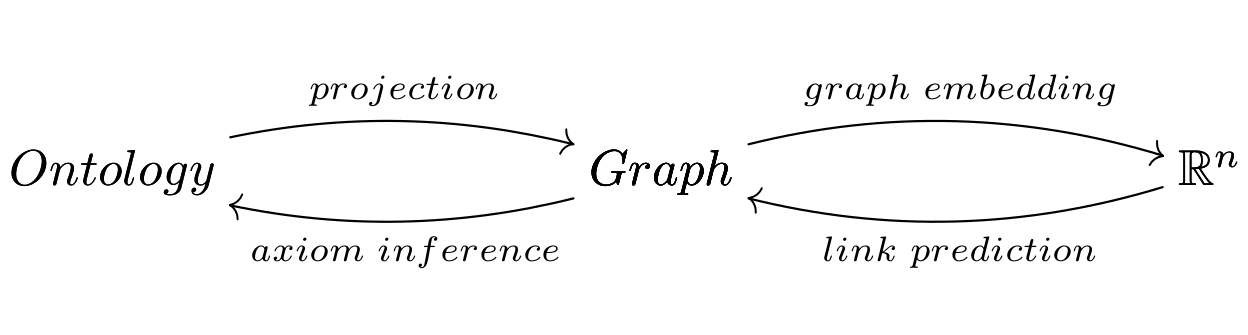
Shows how the choice of graph projection, which axioms it captures and whether it is invertible, determines downstream ontology embedding performance.

From axioms over graphs to vectors, and back again: evaluating the properties of graph-based ontology embeddings

Several approaches have been developed that generate embeddings for Description Logic ontologies and use these embeddings in machine learning. One approach of generating ontologies embeddings is by first embedding the ontologies into a graph structure, i.e., introducing a set of nodes and edges for named entities and logical axioms, and then applying a graph embedding to embed the graph in ℝn. Methods that embed ontologies in graphs (graph projections) have different formal properties related to the type of axioms they can utilize, whether the projections are invertible or not, and whether they can be applied to asserted axioms or their deductive closure. We analyze, qualitatively and quantitatively, several graph projection methods that have been used to embed ontologies, and we demonstrate the effect of the properties of graph projections on the performance of predicting axioms from ontology embeddings. We find that there are substantial differences between different projection methods, and both the projection of axioms into nodes and edges as well ontological choices in representing knowledge will impact the success of using ontology embeddings to predict axioms.

@inproceedings{zhapa2023axioms,
  author       = {Fernando Zhapa{-}Camacho and
                  Robert Hoehndorf},
  editor       = {Artur S. d'Avila Garcez and
                  Tarek R. Besold and
                  Marco Gori and
                  Ernesto Jim{\'{e}}nez{-}Ruiz},
  title        = {From Axioms over Graphs to Vectors, and Back Again: Evaluating the
                  Properties of Graph-based Ontology Embeddings},
  booktitle    = {Proceedings of the 17th International Workshop on Neural-Symbolic
                  Learning and Reasoning, La Certosa di Pontignano, Siena, Italy, July
                  3-5, 2023},
  series       = {{CEUR} Workshop Proceedings},
  volume       = {3432},
  pages        = {85--102},
  publisher    = {CEUR-WS.org},
  year         = {2023},
  url          = {https://ceur-ws.org/Vol-3432/paper7.pdf},
  timestamp    = {Tue, 11 Jul 2023 17:14:10 +0200},
  biburl       = {https://dblp.org/rec/conf/nesy/Zhapa-CamachoH23.bib},
  bibsource    = {dblp computer science bibliography, https://dblp.org}
}
Paper GitHub
icon


A-LIOn - Alignment Learning through Inconsistency negatives of the aligned Ontologies

The 17th International Workshop on Ontology Matching

Sarah M. Alghamdi, Fernando Zhapa-Camacho, Robert Hoehndorf

Learns ontology alignments by combining lexical and semantic signals, using OWL EL reasoning to generate logically inconsistent negatives.

A-LIOn - Alignment Learning through Inconsistency negatives of the aligned Ontologies

Ontologies play an important role in sharing and reusing knowledge. Several ontologies have been developed to describe a particular domain but from different perspectives from communities of developers and users. This has led to the existence of multiple ontologies covering the same or a different domain with varying degrees of variability. Ontology Alignment is typically used to identify correspondences between semantically related elements of two or more ontologies in order to address this problem. We propose A-LIOn a system that learns alignments by combining lexical and semantic approaches as well as machine learning. The system utilizes OWL EL reasoning for negative sampling which is iteratively used to inform the correction of the learning of the alignments. We demonstrate that A-LIOn produces alignments that are coherent with respect to OWL EL.

@inproceedings{DBLP:conf/semweb/AlghamdiZH22,
  author       = {Sarah M. Alghamdi and
                  Fernando Zhapa{-}Camacho and
                  Robert Hoehndorf},
  editor       = {Pavel Shvaiko and
                  J{\'{e}}r{\^{o}}me Euzenat and
                  Ernesto Jim{\'{e}}nez{-}Ruiz and
                  Oktie Hassanzadeh and
                  C{\'{a}}ssia Trojahn},
  title        = {A-LIOn - alignment learning through inconsistency negatives of the
                  aligned ontologies},
  booktitle    = {Proceedings of the 17th International Workshop on Ontology Matching
                  {(OM} 2022) co-located with the 21th International Semantic Web Conference
                  {(ISWC} 2022), Hangzhou, China, held as a virtual conference, October
                  23, 2022},
  series       = {{CEUR} Workshop Proceedings},
  volume       = {3324},
  pages        = {137--144},
  publisher    = {CEUR-WS.org},
  year         = {2022},
  url          = {https://ceur-ws.org/Vol-3324/oaei22\_paper2.pdf},
  timestamp    = {Fri, 10 Mar 2023 16:23:09 +0100},
  biburl       = {https://dblp.org/rec/conf/semweb/AlghamdiZH22.bib},
  bibsource    = {dblp computer science bibliography, https://dblp.org}
}

Paper GitHub


Biomedical applications

INDIGENA: inductive prediction of disease-gene associations using phenotype ontologies

Bioinformatics

Fernando Zhapa-Camacho, Robert Hoehndorf

Ranks candidate disease genes from a set of phenotypes, and unlike earlier embedding methods generalises to diseases unseen at training time.

INDIGENA: inductive prediction of disease-gene associations using phenotype ontologies

Motivation: Predicting gene-disease associations (GDAs) is the problem to determine which gene is associated with a disease. GDA prediction can be framed as a ranking problem where genes are ranked for a query disease, based on features such as phenotypic similarity. By describing phenotypes using phenotype ontologies, ontology-based semantic similarity measures can be used. However, traditional semantic similarity measures use only the ontology taxonomy. Recent methods based on ontology embeddings compare phenotypes in latent space; these methods can use all ontology axioms as well as a supervised signal, but are inherently transductive, i.e., query entities must already be known at the time of learning embeddings, and therefore these methods do not generalize to novel diseases (sets of phenotypes) at inference time. Results: We developed INDIGENA, an inductive disease-gene association method for ranking genes based on a set of phenotypes. Our method first uses a graph projection to map axioms from phenotype ontologies to a graph structure, and then uses graph embeddings to create latent representations of phenotypes. We use an explicit aggregation strategy to combine phenotype embeddings into representations of genes or diseases, allowing us to generalize to novel sets of phenotypes. We also develop a method to make the phenotype embeddings and the similarity measure task-specific by including a supervised signal from known gene-disease associations. We apply our method to mouse models of human disease and demonstrate that we can significantly improve over the inductive semantic similarity baseline measures, and reach a performance similar to transductive methods for predicting gene-disease associations while being more general. Availability and Implementation: https://github.com/bio-ontology-research-group/indigena

@article{Zhapa_Camacho_2026_indigena,
  title={INDIGENA: inductive prediction of disease–gene associations using phenotype ontologies},
  volume={42},
  ISSN={1367-4811},
  url={http://dx.doi.org/10.1093/bioinformatics/btag325},
  DOI={10.1093/bioinformatics/btag325},
  number={6},
  journal={Bioinformatics},
  publisher={Oxford University Press (OUP)},
  author={Zhapa-Camacho, Fernando and Hoehndorf, Robert},
  editor={Robinson, Peter},
  year={2026},
  month=May
}
Paper GitHub


LLM Agent Based Protein Function Prediction

PSB 2026

Fernando Zhapa-Camacho, Olga Mashkova, Robert Hoehndorf, Maxat Kulmanov

An LLM agent that refines protein function predictions by cross-referencing literature, metadata and ontologies, documenting the evidence behind each update.

LLM Agent Based Protein Function Prediction

Protein function prediction remains a fundamental challenge in computational biology. Here, we present a Large Language Model (LLM) agent-based system that improves protein function prediction performance using knowledge-augmented reasoning and multi-source evidence synthesis.

Our approach integrates computational predictions with structured protein metadata, scientific literature, and ontological knowledge through a multi-stage reasoning process. An LLM agent equipped with specialized tools progressively refines functional predictions by querying constraints, cross-referencing evidence, and ensuring biological plausibility. Furthermore, the system provides detailed explanations for each prediction update, documenting the reasoning process and evidence sources.

We evaluate our approach against established baseline methods across three Gene Ontology sub-ontologies using four complementary metrics, achieving superior performance in threshold-dependent measures, attaining the lowest $S_{\min}$ scores across all ontologies and the best $F_{\max}$ for Molecular Function and Cellular Component ontologies. We make our code publicly available at \url{https://github.com/bio-ontology-research-group/go-agent}.

@inproceedings{Zhapa_Camacho_2025,
title={LLM Agent Based Protein Function Prediction},
url={http://dx.doi.org/10.1142/9789819824755_0036},
DOI={10.1142/9789819824755_0036},
booktitle={Biocomputing 2026},
publisher={WORLD SCIENTIFIC},
author={Zhapa-Camacho,
Fernando and Mashkova, Olga and Hoehndorf, Robert and Kulmanov, Maxat},
year={2025},
month=dec,
pages={508–519} }
Paper GitHub


Predicting protein functions using positive-unlabeled ranking with ontology-based priors
ISMB 2024

Fernando Zhapa-Camacho, Zhenwei Tang, Maxat Kulmanov, Robert Hoehndorf

Casts protein function prediction as positive-unlabeled ranking with class priors from the Gene Ontology hierarchy, avoiding the false-negative problem.

Predicting protein functions using positive-unlabeled ranking with ontology-based priors

Automated protein function prediction is a crucial and widely studied problem in bioinformatics. Computationally, protein function is a multilabel classification problem where only positive samples are defined and there is a large number of unlabeled annotations. Most existing methods rely on the assumption that the unlabeled set of protein function annotations are negatives, inducing the false negative issue, where potential positive samples are trained as negatives. We introduce a novel approach named PU-GO, wherein we address function prediction as a positive-unlabeled ranking problem. We apply empirical risk minimization, i.e., we minimize the classification risk of a classifier where class priors are obtained from the Gene Ontology hierarchical structure. We show that our approach is more robust than other state-of-the-art methods on similarity-based and time-based benchmark datasets. Data and code are available at https: //github.com/bio-ontology-research-group/PU-GO.

@article {Zhapa-Camacho2024.01.28.577662,
	  author = {Fernando Zhapa-Camacho and Zhenwei Tang and Maxat Kulmanov and Robert Hoehndorf},
          title = {Predicting protein functions using positive-unlabeled ranking with ontology-based priors},
          elocation-id = {2024.01.28.577662},
          year = {2024},
          doi = {10.1101/2024.01.28.577662},
          publisher = {Cold Spring Harbor Laboratory},
          abstract = {Automated protein function prediction is a crucial and widely studied problem in bioinformatics. Computationally, protein function is a multilabel classification problem where only positive samples are defined and there is a large number of unlabeled annotations. Most existing methods rely on the assumption that the unlabeled set of protein function annotations are negatives, inducing the false negative issue, where potential positive samples are trained as negatives. We introduce a novel approach named PU-GO, wherein we address function prediction as a positive-unlabeled ranking problem. We apply empirical risk minimization, i.e., we minimize the classification risk of a classifier where class priors are obtained from the Gene Ontology hierarchical structure. We show that our approach is more robust than other state-of-the-art methods on similarity-based and time-based benchmark datasets. Data and code are available at https://github.com/bio-ontology-research-group/PU-GO.Competing Interest StatementThe authors have declared no competing interest.},
        URL = {https://www.biorxiv.org/content/early/2024/01/31/2024.01.28.577662},
        eprint = {https://www.biorxiv.org/content/early/2024/01/31/2024.01.28.577662.full.pdf},
        journal = {bioRxiv}
}
Paper GitHub
icon


Prioritizing genomic variants through neuro-symbolic, knowledge-enhanced learning

Bioinformatics, Volume 40, Issue 5

Azza Althagafi, Fernando Zhapa-Camacho, Robert Hoehndorf

Prioritises genomic variants in rare-disease diagnosis by combining molecular features with ontology-based knowledge of phenotype consequences.

Prioritizing genomic variants through neuro-symbolic, knowledge-enhanced learning

Motivation: Whole-exome and genome sequencing have become common tools in diagnosing patients with rare diseases. Despite their success, this approach leaves many patients undiagnosed. A common argument is that more disease variants still await discovery, or the novelty of disease phenotypes results from a combination of variants in multiple disease-related genes. Interpreting the phenotypic consequences of genomic variants relies on information about gene functions, gene expression, physiology, and other genomic features. Phenotype-based methods to identify variants involved in genetic diseases combine molecular features with prior knowledge about the phenotypic consequences of altering gene functions. While phenotype-based methods have been successfully applied to prioritizing variants, such methods are based on known gene–disease or gene–phenotype associations as training data and are applicable to genes that have phenotypexss associated, thereby limiting their scope. In addition, phenotypes are not assigned uniformly by different clinicians, and phenotype-based methods need to account for this variability.

Results: We developed an Embedding-based Phenotype Variant Predictor (EmbedPVP**, a computational method to prioritize variants involved in genetic diseases by combining genomic information and clinical phenotypes. EmbedPVP leverages a large amount of background knowledge from human and model organisms about molecular mechanisms through which abnormal phenotypes may arise. Specifically, EmbedPVP incorporates phenotypes linked to genes, functions of gene products, and the anatomical site of gene expression, and systematically relates them to their phenotypic effects through neuro-symbolic, knowledge-enhanced machine learning. We demonstrate EmbedPVP’s efficacy on a large set of synthetic genomes and genomes matched with clinical information.

Availability and Implementation: EmbedPVP and all evaluation experiments are freely available at https://github.com/bio-ontology-research-group/EmbedPVP

@article {Althagafi2023.11.08.566179,
        author = {Azza Althagafi and Fernando Zhapa-Camacho and Robert Hoehndorf},
        title = {Prioritizing genomic variants through neuro-symbolic, knowledge-enhanced learning},
        elocation-id = {2023.11.08.566179},
        year = {2023},
        doi = {10.1101/2023.11.08.566179},
        publisher = {Cold Spring Harbor Laboratory},
        URL = {https://www.biorxiv.org/content/early/2023/11/13/2023.11.08.566179},
        eprint = {https://www.biorxiv.org/content/early/2023/11/13/2023.11.08.566179.full.pdf},
        journal = {bioRxiv}
}
Paper GitHub


DeepGOWeb: fast and accurate protein function prediction on the (Semantic) Web

Nucleic Acids Research

Maxat Kulmanov, Fernando Zhapa-Camacho, Robert Hoehndorf

Serves the DeepGOPlus protein function predictor over a website, an API and SPARQL, keeping predictions consistent with the Gene Ontology.

DeepGOWeb: fast and accurate protein function prediction on the (Semantic) Web

Understanding the functions of proteins is crucial to understand biological processes on a molecular level. Many more protein sequences are available than can be investigated experimentally. DeepGOPlus is a protein function prediction method based on deep learning and sequence similarity. DeepGOWeb makes the prediction model available through a website, an API, and through the SPARQL query language for interoperability with databases that rely on Semantic Web technologies. DeepGOWeb provides accurate and fast predictions and ensures that predicted functions are consistent with the Gene Ontology; it can provide predictions for any protein and any function in Gene Ontology. DeepGOWeb is freely available at (https://deepgo.cbrc.kaust.edu.sa/)

@article{10.1093/nar/gkab373,
    author = {Kulmanov, Maxat and Zhapa-Camacho, Fernando and Hoehndorf, Robert},
    title = "{DeepGOWeb: fast and accurate protein function prediction on the (Semantic) Web}",
    journal = {Nucleic Acids Research},
    volume = {49},
    number = {W1},
    pages = {W140-W146},
    year = {2021},
    month = {05},
    issn = {0305-1048},
    doi = {10.1093/nar/gkab373},
    url = {https://doi.org/10.1093/nar/gkab373},
    eprint = {https://academic.oup.com/nar/article-pdf/49/W1/W140/38841723/gkab373.pdf},
}
Paper


Software, surveys and overviews

Ontology Embedding: A Survey of Methods, Applications and Resources

IEEE TKDE

Jiaoyan Chen, Olga Mashkova, Fernando Zhapa-Camacho, Robert Hoehndorf, Yuan He, Ian Horrocks

A systematic survey of ontology embedding: formal definitions, families of methods, applications and available resources.

Ontology Embedding: A Survey of Methods, Applications and Resources

Ontologies are widely used for representing domain knowledge and meta data, playing an increasingly important role in Information Systems, the Semantic Web, Bioinformatics and many other domains. However, logical reasoning that ontologies can directly support are quite limited in learning, approximation and prediction. One straightforward solution is to integrate statistical analysis and machine learning. To this end, automatically learning vector representation for knowledge of an ontology i.e., ontology embedding has been widely investigated in recent years. Numerous papers have been published on ontology embedding, but a lack of systematic reviews hinders researchers from gaining a comprehensive understanding of this field. To bridge this gap, we write this survey paper, which first introduces different kinds of semantics of ontologies, and formally defines ontology embedding from the perspectives of both mathematics and machine learning, as well as its property of faithfulness. Based on this, it systematically categorises and analyses a relatively complete set of over 80 papers, according to the ontologies and semantics that they aim at, and their technical solutions including geometric modeling, sequence modeling and graph propagation. This survey also introduces the applications of ontology embedding in ontology engineering, machine learning augmentation and life sciences, presents a new library mOWL, and discusses the challenges and future directions.

@article{Chen_2025,
  title={Ontology Embedding: A Survey of Methods, Applications and Resources},
  ISSN={2326-3865},
  url={http://dx.doi.org/10.1109/TKDE.2025.3559023},
  DOI={10.1109/tkde.2025.3559023},
  journal={IEEE Transactions on Knowledge and Data Engineering},
  publisher={Institute of Electrical and Electronics Engineers (IEEE)},
  author={Chen, Jiaoyan and Mashkova, Olga and Zhapa-Camacho, Fernando and Hoehndorf, Robert and He, Yuan and Horrocks, Ian},
  year={2025},
  pages={1–20}
}
Paper


Neuro-Symbolic AI in Life Sciences

Frontiers in Artificial Intelligence and Applications

Robert Hoehndorf, Catia Pesquita, Fernando Zhapa-Camacho

Book chapter surveying how neuro-symbolic methods meet the demands of life-science knowledge, from ontologies and annotation models to scale, and what remains open.

Neuro-Symbolic AI in Life Sciences

Life sciences have a long history of driving advancements in various disciplines, including mathematics, philosophy, and logic. In recent years, life sciences have also become a significant application area for Artificial Intelligence (AI) technologies, including for neuro-symbolic AI methods. The life sciences knowledge infrastructure, characterized by its widespread use of ontologies, complex annotation models, large size, and community standards, presents unique challenges and opportunities for neuro-symbolic AI. We outline how neuro-symbolic methods have been applied and developed to address these challenges. We describe semantic similarity measures, knowledge graph embeddings, ontology embeddings, and knowledge-enhanced learning in the context of formalized life science knowledge. While there has been significant progress, we also outline multiple remaining challenges that provide opportunities for future research.

@inbook{Hoehndorf_2025,
title={Neuro-Symbolic AI in Life Sciences},
ISBN={9781643685793},
ISSN={1879-8314},
url={http://dx.doi.org/10.3233/FAIA250239},
DOI={10.3233/faia250239},
booktitle={Handbook on Neurosymbolic AI and Knowledge Graphs},
publisher={IOS Press},
author={Hoehndorf,
Robert and Pesquita, Catia and Zhapa-Camacho, Fernando},
year={2025}, month=mar }
Paper


mOWL: Python library for machine learning with biomedical ontologies

Bioinformatics, Volume 39, Issue 1

Fernando Zhapa-Camacho, Maxat Kulmanov, Robert Hoehndorf

A Python library packaging ontology embedding methods into reusable primitives for machine learning with biomedical ontologies.

mOWL: Python library for machine learning with biomedical ontologies

Motivation Ontologies contain formal and structured information about a domain and are widely used in bioinformatics for annotation and integration of data. Several methods use ontologies to provide background knowledge in machine learning tasks, which is of particular importance in bioinformatics. These methods rely on a set of common primitives that are not readily available in a software library; a library providing these primitives would facilitate the use of current machine learning methods with ontologies and the development of novel methods for other ontology-based biomedical applications.

Results We developed mOWL, a Python library for machine learning with ontologies formalized in the Web Ontology Language (OWL). mOWL implements ontology embedding methods that map information contained in formal knowledge bases and ontologies into vector spaces while preserving some of the properties and relations in ontologies, as well as methods to use these embeddings for similarity computation, deductive inference and zero-shot learning. We demonstrate mOWL on the knowledge-based prediction of protein–protein interactions using the gene ontology and gene–disease associations using phenotype ontologies.

@article{10.1093/bioinformatics/btac811,
	author = {Zhapa-Camacho, Fernando and Kulmanov, Maxat and Hoehndorf, Robert},
    	title = "{mOWL: Python library for machine learning with biomedical ontologies}",
    	journal = {Bioinformatics},
    	year = {2022},
    	month = {12},
    	issn = {1367-4803},
    	doi = {10.1093/bioinformatics/btac811},
    	url = {https://doi.org/10.1093/bioinformatics/btac811},
    	note = {btac811},
   	}
Paper GitHub
icon


Other

Successive Adaptive Linear Neural Modeling for Equidistant Real Roots Finding

ETCM 2018

Joseph R. González, Fernando Zhapa-Camacho, Oscar V. Guarnizo, Francisco Ortega-Zamorano

Finds equidistant real roots with a self-organising map that localises each root, followed by Adaline regression within each region.

Successive Adaptive Linear Neural Modeling for Equidistant Real Roots Finding

The main objective of this work has been to implement a model to find equidistant real roots using a Successive Adaptive Linear Neural Modeling which uses two approaches: a Self Organized Map (SOM) and an Adaptative Linear Neuron (Adaline). A SOM model has been used with a new neighborhood function Λ, and a physical distance β with which the task is divided in sub-processes reducing the complexity of the task because the SOM model can delimited the areas where a single root exist. Then, through a successive approach, it is applied an Feed-forward neural model with a learning process base on Adaline neuron with pocket in each pair of regions for finding the real root values with a reduced precision. Finally, several experiments were done consider CPU time, relative error, distance between the roots and polynomial degrees. The results show that the time complexity grows in a linear or logarithmic way. Also, the error does not increase in a higher rate than the degree of polynomial or the root distance.

@INPROCEEDINGS{8580280,
  author={González, Joseph R. and Zhapa, Fernando P. and Guarnizo, Oscar V. and Ortega-Zamorano, Francisco},
  booktitle={2018 IEEE Third Ecuador Technical Chapters Meeting (ETCM)}, 
  title={Successive Adaptive Linear Neural Modeling for Equidistant Real Roots Finding}, 
  year={2018},
  volume={},
  number={},
  pages={1-6},
  doi={10.1109/ETCM.2018.8580280}}
Paper